

Project Description:
2025 marks the International Year of Glacier Preservation. In this context, the GV-CLIMA project will involve 80 citizen scientists in the Aosta Valley in monitoring the quality of meltwater from the Pré de Bar glacier. Participants, guided by local alpine experts, will collect environmental data using accessible, low-cost methods and contribute emotional narratives reflecting their experiences and perceptions of climate change. This dual approach—science and storytelling—aims to foster deeper public engagement and a more holistic understanding of glacier retreat. Activities will include field campaigns, training sessions, and a final cultural event where scientific results and citizen stories will be presented to the public and local authorities. The project is designed not only to raise awareness but also to empower communities and inform climate adaptation strategies through open data and participatory action.
Project Type: Kickstarter
Theme: Public Trust, Education and Empowerment
Mentor: Jacqueline Goldin
Glacier Voices for Climate Action: Listening to a Vanishing Glacier
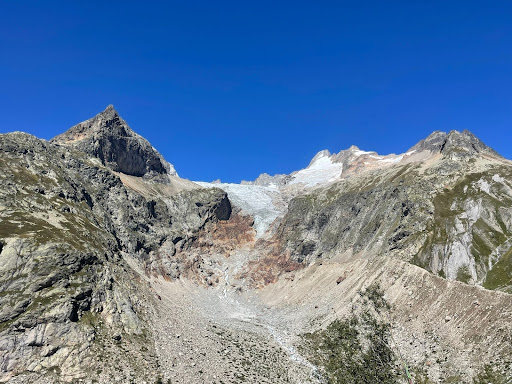
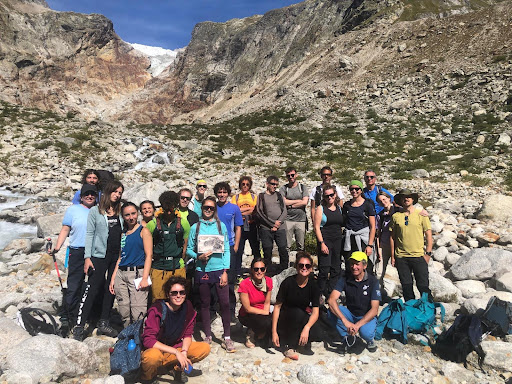
“Glacier Voices for Climate Action” is a citizen science initiative designed and led by Source International in partnership with CAI Valle d’Aosta and supported by the IMPETUS Accelerator. The project took place in Val Ferret in the Aosta Valley, at the foot of the rapidly retreating Pré de Bar glacier, a valley glacier on the Italian side of the Mont Blanc massif. Over four months, from June to September 2025, 88 citizen scientists joined the team to monitor both the physical and emotional impacts of glacial retreat, combining environmental measurements with human-centred observations.
What we did
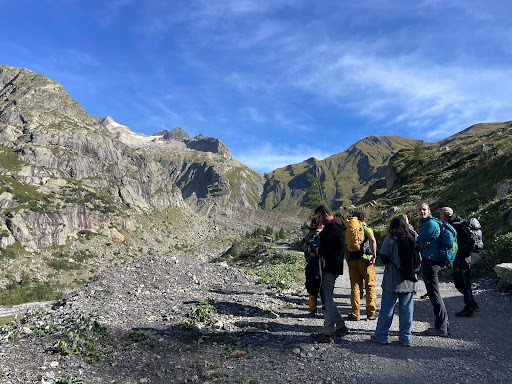
Each month, participants joined “science emotional trekking” routes, walking from the last bus stop in the valley, Arpnouva, to the glacier front. Equipped with field instruments such as a multiparameter probe and a turbidity tube, participants and researchers measured meltwater characteristics including temperature, pH, turbidity, electrical conductivity, dissolved oxygen and total dissolved solids. Two monitoring points along the Dora Ferret stream allowed the team to track changes between the glacier front (A1) and a downstream location (A2).
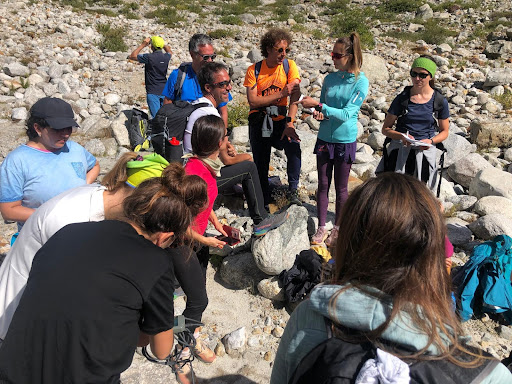
Alongside scientific measurements, participants completed an anonymous emotional-response questionnaire designed to explore the psychological dimensions of climate change. The survey captured reflections on memory, emotional reactions, eco-anxiety, perceived responsibility and intentions to adopt climate-friendly behaviours.
Why it matters
The retreat of the Pré de Bar glacier is both dramatic and well documented. Historic photographs gathered from the regional library show a retreat of around one kilometre since the late nineteenth century, with a notable acceleration in recent years. The summer of 2025 brought extreme heat to the Aosta Valley, pushing the 0°C isotherm above 5,000 metres.
This intense warming drove early and strong glacial melt, reflected in unusually high turbidity readings in late June, reaching 100 NTU at site A2. Meltwater became progressively clearer and colder in August and September. Understanding these changes at a local scale helps communities connect with the wider global trend of rapid glacial loss, which threatens water security, ecosystems and cultural heritage.
What IMPETUS enabled us to achieve
Support from the IMPETUS Accelerator provided the funding, mentoring and visibility needed to build a strong citizen science programme. With this backing, the team was able to:
• co-design a participatory monitoring protocol
• train citizens to use scientific instruments and collect high-quality data
• integrate emotional-response research into environmental monitoring
• build an open-access dataset with KoboToolbox
• host a public event in Aosta to share findings and foster dialogue
Participation in IMPETUS strengthened the project’s capacity to combine scientific rigour with participatory climate engagement, laying the groundwork for expanding this model to other alpine and non-alpine regions.
What we learned
The results reveal a strong link between scientific data and emotional experience:
• 85 % of participants felt personally affected by the glacier’s retreat
• 81 % reported feelings of discomfort or distress when witnessing climate impacts
• 77 % said the trekking increased their motivation to act, particularly through sustainable mobility, dietary changes or civic engagement
As one participant noted, “Seeing the glacier disappear with my own eyes made climate change real. Sharing this experience with others gave me hope that collective action is possible.”
What comes next
Glacier Voices for Climate Action will continue in a new form in 2026, with updated measurement activities, expanded tools for documenting emotional impact and new collaborations with schools and local institutions. Source International also aims to replicate this model on other glaciers in Italy, including sites affected by environmental pollution, with the goal of creating a national network of glacier-focused citizen science. By bringing people face-to-face with disappearing ice, the initiative seeks to strengthen scientific understanding and collective resilience, ensuring that glaciers continue to have a voice even as they diminish.