
Project Description:
UNIQUE seeks to embrace the needs and perspectives of target groups within the proximity-city framework by including the final users’ perspective from the project’s inception. They will help shape, analyse and detect potential flaws in current participatory tools, such as the Proximity Flower. This would enable us to improve the design of urban spaces so that everyone feels welcome and included. The participation would consist of activities such as co-creating the inclusive “proximity flower”. This tool is used to gather information from neighbours in specific areas, enabling them to indicate which city services they want near their homes to foster proximity mobility. This activity aims to engage citizens through handicrafts and art to increase participation. However, it needs to be updated to accommodate everyone in the process, including people with disabilities who may face different barriers when using this tool, thereby being indirectly excluded.
Project Type: Sustaining
Theme: Public Trust, Education and Empowerment
Mentor: Cristina Luís
Designing Inclusion: The UNIQUE Project and the Flower of Proximity
People with disabilities are often excluded from research and public consultation or treated as passive subjects of study. The UNIQUE Project set out to change this by making people with disabilities active contributors and citizen scientists. Led by the Universidad Politécnica de Madrid and the Asociación PUEDO, the project focused on creating an inclusive version of the Flower of Proximity.
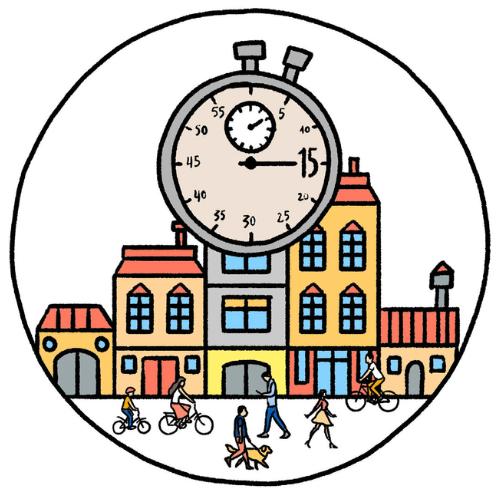
The Flower of Proximity is an urban-planning tool used to gather information from citizens about the services, activities, and spaces they need close to home, thereby helping to shape the City of Proximity. Traditional workshops relied on paper-based models that were unsuitable for people with severe visual impairments, challenging for participants with cognitive or hearing disabilities and complex to use for anyone with muscular or neurological conditions.
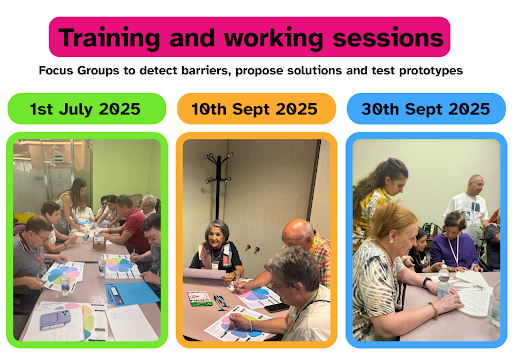
Supported first by an IMPETUS Kickstarting Grant in 2024 and later by a Sustaining Grant in 2025, UNIQUE developed accessible alternatives to the traditional Flower of Proximity. In the first phase, the team assessed existing models and produced rough prototypes for testing. In the second phase, an improved version was completed, culminating in inclusive workshops where people with and without disabilities worked together in a non-segregated, accessible environment.
Developing inclusive models
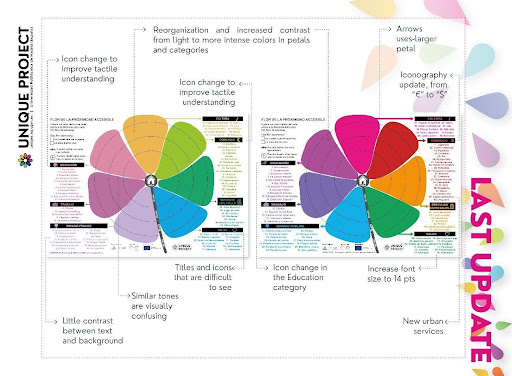
It quickly became clear that a single universal tool could not meet all needs. The team therefore created two complementary versions:
• a paper model inspired by the traditional format
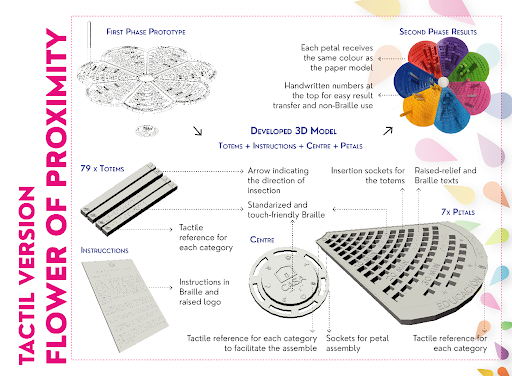
• a tactile-Braille model designed for people with severe visual disabilities, but usable by anyone, including those unfamiliar with Braille
Three focus groups involving 23 citizen scientists identified barriers and generated solutions based on their lived experience. Their insights informed improvements to both models, including adjustments related to chromatic accessibility. These changes enhanced clarity, access and ease of use, enabling people with and without disabilities to participate together naturally.
Testing the models in practice
Two applied workshops attracted approximately 20 participants in the first session and approximately 40 in the second. No accessibility issues were reported. The paper model followed the original three-step methodology:
-
Individual flower – each participant completed their own model.
-
Group flower – small groups collaborated to create a shared flower that accommodated everyone’s needs.
-
Discussion – participants collectively analysed and discussed the results.
For the tactile version, the first two steps were merged to enable collaboration from the outset, regardless of ability.
What IMPETUS made possible
Participation in the IMPETUS programme enabled the tool’s improvement and update. Thanks to its training, guidance and resources, the project achieved strong results, building on thorough testing and validation. Collaboration with researchers and institutions in other countries enabled the team to produce materials in multiple languages, thereby increasing their transferability. All resources are openly available online while the team seeks additional funding to continue developing and expanding the work.
Website: www.unique.aq.upm.es