
Project Description:
Soil Your Scarf empowers participants with accessible and DIY tools to assess the life in their own soil. Through the process of creating the tools and the discussions that arise during the act of making, participants share their own experiences with soil ecology and learn about reducing textile waste and the use of fully compostable fibres in textile production as part of a circular economy. The nature of the project tends to attract people who may not otherwise feel welcome in scientific spaces, especially in soil science and agriculture. Participants are knitters with gardens, sheep farmers, horticulture students, community garden growers, food forest project participants, and community flax-growing groups. The project’s findings will provide valuable data for a better understanding of soil biodiversity in Ireland and will inform soil conservation and care through policy and education.
Project Type: Kickstarter
Theme: Resource Management
Mentor:Ilidio Andre
Soil Your Scarf: Participatory Science Research
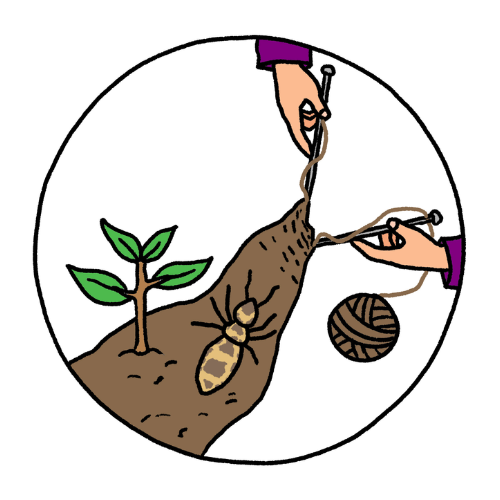
We depend on soil to live, yet it is deteriorating at an alarming rate due to current land-use practices. Soil Your Scarf is a citizen science initiative led by an ecologist and educator in Ireland. It invites participants to come together to knit tiny wool scarves to help change how we think about and care for our soil.
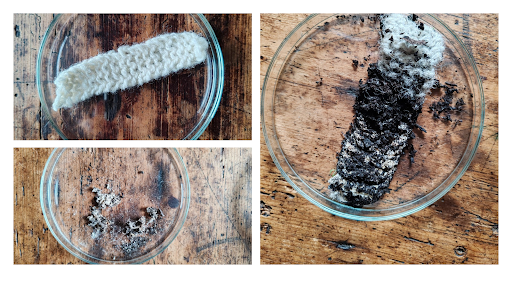
At a basic level, we can roughly gauge soil biological activity by burying a scarf and checking what remains after two months. If the scarf has broken down into fragments, it is a good indication of high biological activity. If it remains largely intact, this suggests there is more we can do to support soil health. By digging a little deeper, we can also examine the scarves under a microscope to see the soil life living within our soils.
Why tiny scarves?
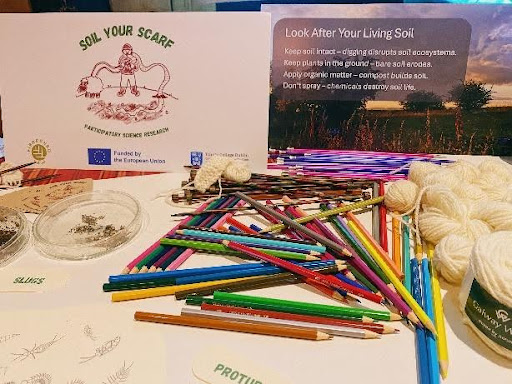
First, gathering together to knit and chat is an enjoyable way to create, relax, and learn about soil science. This DIY “scientific measuring device” is relatively inexpensive and can be made by anyone with basic knitting skills or a willingness to learn.
Second, Ireland produces a large amount of wool, yet it has little economic value due to the widespread use of petroleum-based textiles. Synthetic, plastic-based textiles can take hundreds of years to break down and contribute to significant waste and pollution problems.
Wool, on the other hand, is compostable. When wool textiles reach the end of their useful life, they can be returned to the soil to provide valuable nutrients and soil-building organic matter. But how does this composting process actually work?
Incredible Soil Animals!
Soil formation is extremely slow and occurs through a combination of physical, chemical, and biological processes. It is the biological processes that transform compostable materials such as plants, leaves, and wool into the rich organic matter that creates healthy, fertile soil.
When we bury our scarves, bacterial and fungal communities colonise and begin to degrade the wool. Larger organisms, known as soil mesofauna, then feed on bacteria and fungi, thereby further breaking down wool fibres. At this stage, we can examine the scarves under a microscope and observe these animals at work. We record the types of organisms present, their abundance, and their behaviour. This helps us better understand how our aboveground actions influence the soil-building life belowground.
The IMPETUS Programme
The Impetus programme has been invaluable in supporting the project through guidance, networking opportunities, and mentoring. This support has strengthened our ability to demonstrate impact and plan next steps.
Although Kapta proved easy to use, its data protocol was complex and raised concerns about long-term maintenance costs. To address this, Sapelli was introduced as a complementary tool. While less scalable, Sapelli was better adapted to the local context and supported by additional training, helping ensure sustainability beyond the funding period.
What’s next?
From spring onwards, Soil Your Scarf will work with communities in public libraries to write, draw, and map our conversations, collaboratively sharing our findings. Keep an eye out for the Soil Your Scarf book!